Instead of Watching AI Spend, Here's How to Route It Effectively
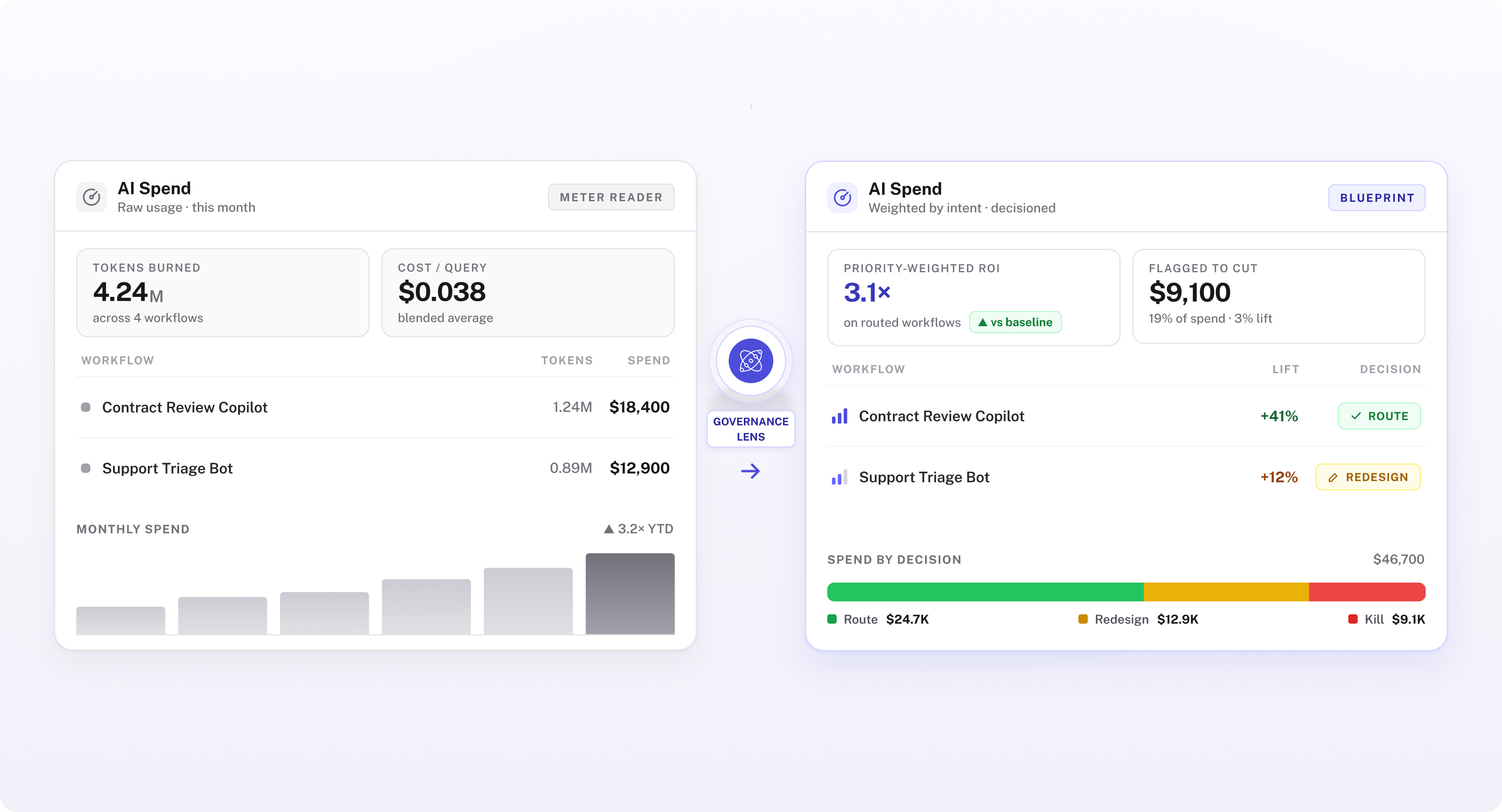
In the past 18 months, enterprises have experimented heavily and spent freely on AI (“tokenmaxxing”) to see what worked for their organization. Now, as the cost of AI use rises, many companies are moving to a “tokenminning” approach.
With CFOs and leadership scrutinizing AI spend, they’re also realizing it’s difficult to know what’s driving ROI and how. It’s risky and unclear how to proceed. You can’t freeze spending and kill innovation, dole out budgets arbitrarily, or just run everything indefinitely.
What you need is an AI blueprint that shows you what you’re building, ensuring it’s up to standards, and the ROI it’s delivering—not just a utility meter counting usage.
The Problem: Most Tools Give You A Utility Meter
The easy fix enterprises reach for first is cost visibility. Dashboards that show tokens burned per team, cost per model, cost per query. These serve as AI FinOps utility meters, which tell you raw numbers but not necessarily how they ladder up to what matters to you:
- Business priority. Meters can’t say if the spend is tied to something leadership actually cares about.
- Initiative type. It can't tell a production system from an abandoned pilot quietly burning tokens.
- Demonstrated ROI. It shows cost, not what happens after it’s spent.
- Model fit. It can't tell you a workload is running on an oversized, overpriced model when a smaller one would do the job for a fraction of the cost.
- Risk and compliance. Something that appears to be a low cost option could be running high risk, and you’d have no idea.
For example, let’s say a claims-summarization tool's token spend triples in a quarter. The meter shows the spike, but it can't say if it’s a truly validated production system or three different teams running their own version of the same thing. It’s also unclear if the task is sitting on a model three times too big for the job, or scoped perfectly for this use case.
With raw usage metrics, leadership sees dollar signs without a clear strategy on how to address costs. They might cut spend that was actually working, or give more budget to something that was driving results and spend simply because it’s the most visible.
The Solution: An AI Blueprint for Cost Management, Not Just Cost Visibility
A utility meter answers “how much” whereas a blueprint answers “where and how well?”
Having full context means you see the memo that set the priority prompting a team to use the model in the first place, the ticket where the model got picked, and the baseline set at launch. A meter has none of that. A blueprint is where these pieces of context all live and interact together, and this is what AlignAI captures.
For the claims-summarization example, this could look like not only seeing the cost-to-run token spike, but also the company KPI about claims cycle-time being a priority, and who owns the call if something needs to change. So when it spikes and the team needs to review, they see the exact details they need to make the right call.
Zoom out to the portfolio level and the same logic scales: a view of spend by bet type (core, growth, or frontier) shows leadership if 40% of compute is going to frontier bets with no proven value yet. It’s not automatically right or wrong, but a decision that should be made consciously.
The Bottom Line: Route Your Spend Wisely
Maximizing the value of a token doesn’t mean you have to “tokenmax” or be overly restrictive on AI budgets. It's about knowing which tokens are earning their keep and which ones are dead weight. Trying to do this with a meter reader won’t lead to strategic decisions the way an AI Blueprint can.
See how AlignAI can help you turn AI spend into prioritized investment → Book a demo
FAQs
1. What is "tokenmaxxing"?
“Tokenmaxxing” is when enterprises spend freely on AI experimentation to find what works, with less regard for cost and efficiency. As AI costs rise and CFOs scrutinize usage, companies are shifting to a more disciplined approach (sometimes called "tokenminning").
2. What's the difference between AI cost visibility and AI cost management?
Cost visibility tells you how much you're spending — tokens burned, cost per model, cost per query. Cost management tells you whether that spend is earning its keep: tied to a business priority, running on the right model, and delivering demonstrated ROI. Most AI FinOps tools solve visibility. Few solve management.
3. How should enterprises prioritize AI compute budget across a portfolio?
Budget should follow strategic priority and demonstrated value. Seeing spend by bet type (core, growth, frontier) also shows leadership when disproportionate compute is going to unproven bets, so that's a conscious decision rather than an accident.
4. Can expensive AI still carry high risk?
Yes. Risk and compliance need to be assessed as their own domain, not inferred from spend or pricing.