Crushed by the AI Elephant: Why Enterprise AI Programs Stall and the Blueprint to Fix It

At ODSC East 2026, our co-founder and CEO Rehgan Bleile started her keynote with a show of hands.
"How many of you have been a part of a machine learning or AI project where something was lost in translation, and it caused a catastrophic issue?"
The hands went up. The keynote that followed was a diagnosis of why this happens and a working blueprint to fix it. With a packed house for her standing-room-only keynote, we’re sharing the best of her talk for everyone. You can watch the full keynote on YouTube, or get a quick recap with our blog.
Setting the Stage: The Blind Men and the AI Elephant
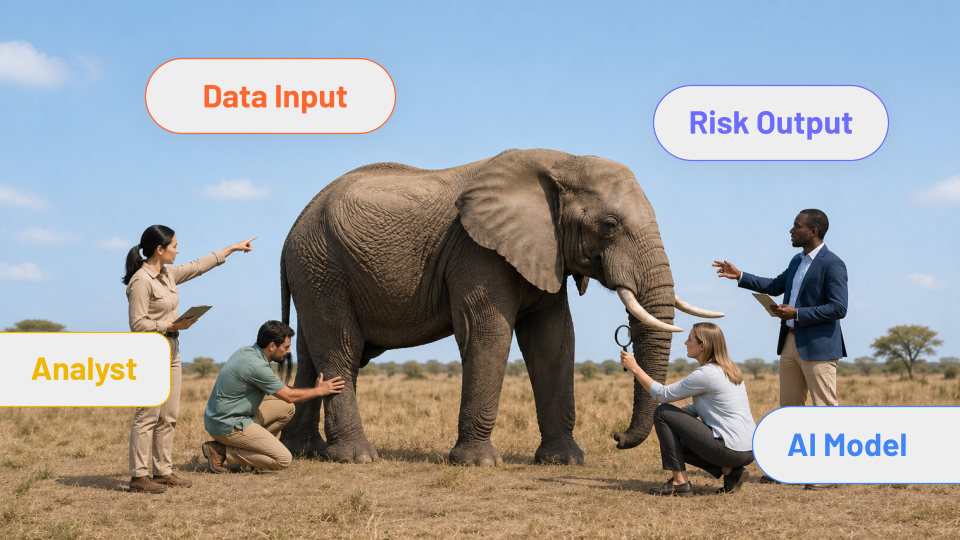
Rehgan opened with the old parable: as each man touched a different part of an elephant, they felt something entirely different: a snake, a tree, or a rope.
That's enterprise AI today.
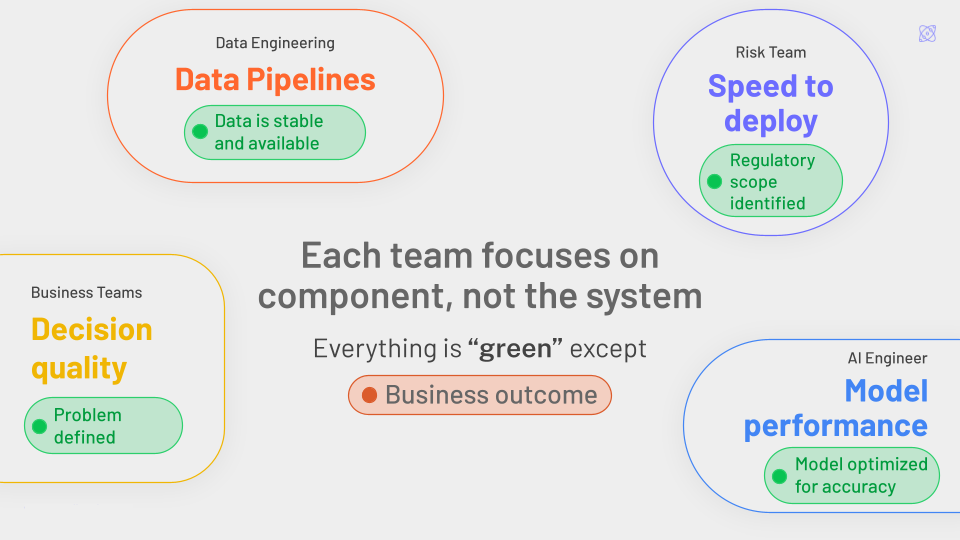
- Data teams see architecture, scalability, quality, and availability.
- AI teams see model performance, accuracy, and deployment speed.
- Risk teams see a moving target of regulations, policies, and risk appetite.
- Business teams see workflows, adapting to AI use, and hitting their targets.
- Executives see a roadmap and a value target.
Each team's piece is real and complex. In isolation they might look complete and functional. But as Rehgan pointed out, “seeing only parts means the gaps don’t show up until it’s too late.” Usually somewhere close to production when going back is expensive.
The Problem: “Everything's Green" on the Surface Doesn’t Capture the Complex Reality Underneath
Every team has its own definition of "ready,” which can cause “translation problems” when things move to production.
Rehgan has seen this play out time and time again. Dozens of teammates work across hundreds of hours of meetings and emails, scattered across a tech stack to still take 9-12 months to go live, meaning they’re also contending with executive impatience when things don’t move faster, and the system losing relevance or efficacy when it finally does ship.
"If we analyze why AI programs move slowly and really look at the root cause, it is truly a translation problem." — Rehgan Bleile, Co-Founder & CEO @ AlignAI
The Solution: A Shared AI Blueprint
AI systems are expensive to build. Failure can mean real damage inside and outside the enterprise. That’s why every other expensive, high-stakes thing we build—homes, bridges, aircraft—gets a blueprint.
An AI system should too. But in this case, the blueprint can’t be a static doc. It needs to be a dynamic, centralized, connected spec that every team contributes to and can iterate on quickly. Four dimensions hold it together:
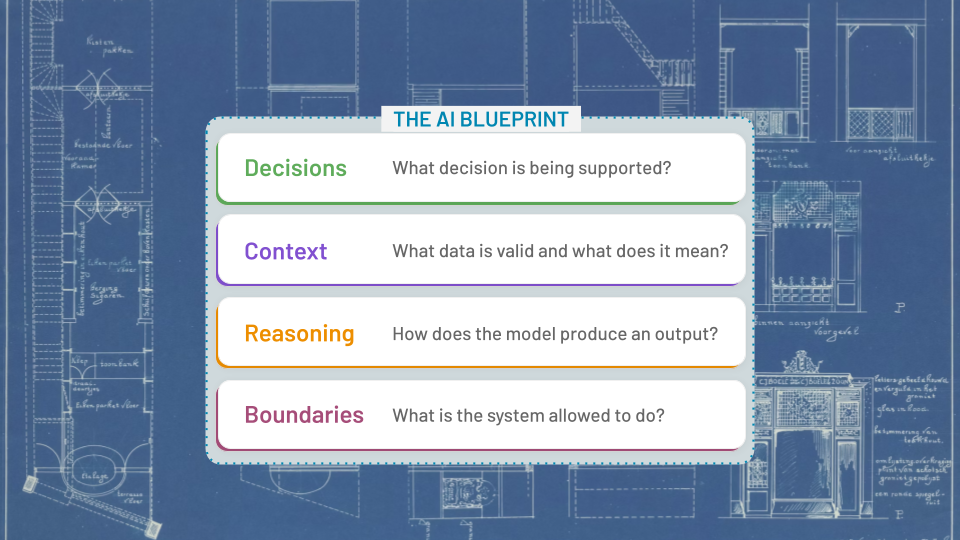
- Decisions — What is the system actually deciding?
- Context — What data is valid, and what does it mean?
- Reasoning — How does the system produce its output?
- Boundaries — What is the system allowed to do?
An Example: The AI Blueprint for a Credit Risk Model
Rehgan walked through the different blueprint dimensions for a use case most financial services teams know well: a credit risk model predicting probability of default.
Decisions — What is the system actually deciding?
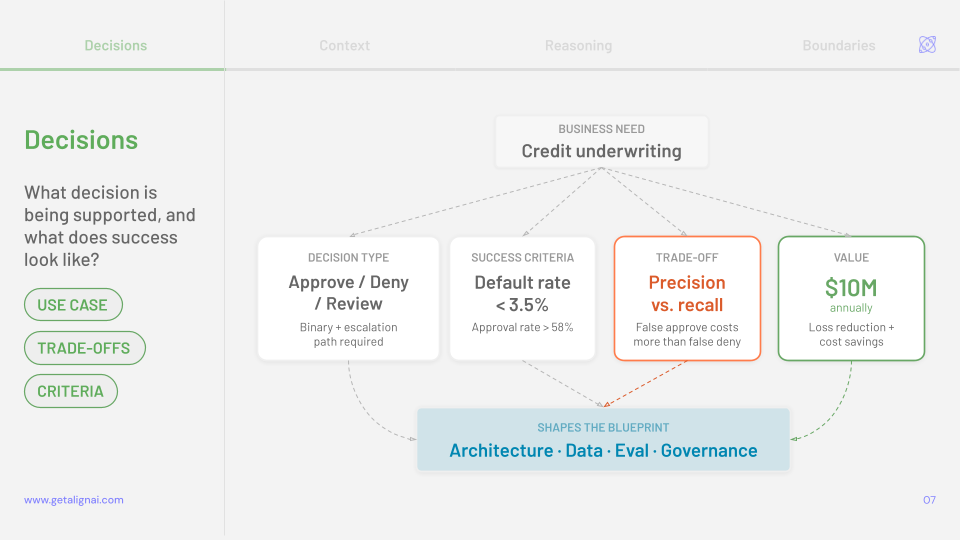
Decision type, trade-offs, success criteria, value.
For a credit risk model: is it approve, deny, review? Is a false approval more costly than a false denial? Is the target a 3.5% default rate or a 58%+ approval rate? Decision outcomes and priorities shape the entire blueprint downstream.
Context — What data is valid, and what does it mean?
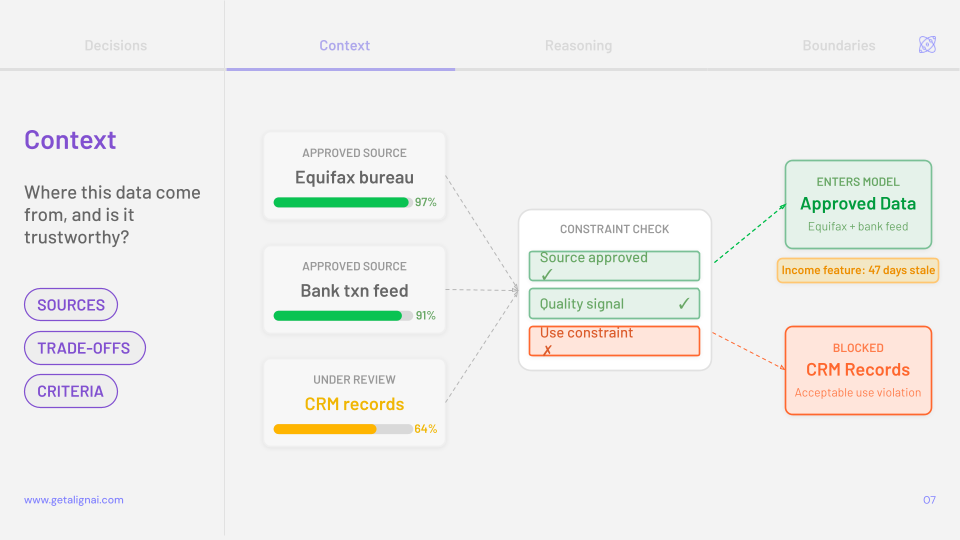
Sources, quality signals, use constraints.
Quality is contextual. It's not just “does the data exist?” It’s also asking where, how it’s accessed, and acceptable uses of it. For example, bureau data approved for underwriting may not be approved for credit line management or marketing offers. Same data, different acceptable-use answers.
*Data readiness was the #2 blocker in a survey AlignAI ran with financial services AI leaders.
Reasoning — How does the system produce its output?
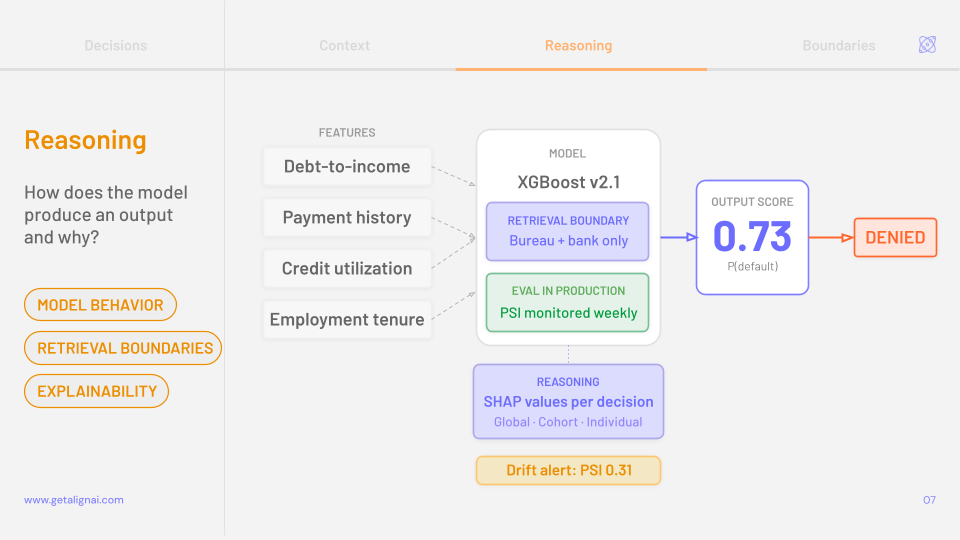
Model behavior, retrieval boundaries, explainability.
In financial services, explainability is often a legal requirement (e.g., FCRA adverse action notices). You need to legally explain in this particular use case why somebody was denied a loan.
Boundaries — What is the system allowed to do?
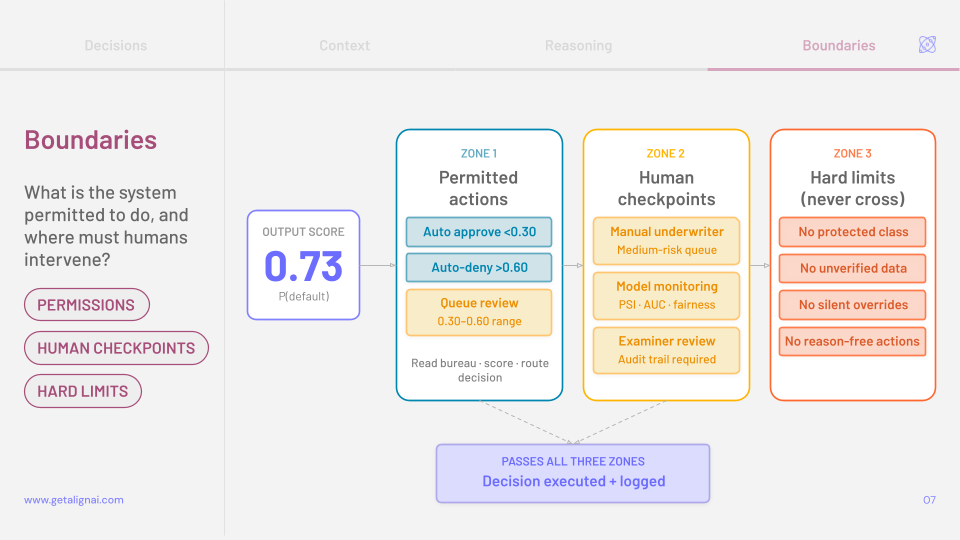
Permissions, human checkpoints, hard limits.
Create a centralized repository of all the boundaries that need to exist from universal ones to contextualized use cases. When you connect them, then you’re working within a set of constraints and bubbling up considerations in the design process.
A credit model that auto-approves below a 0.30 default probability and auto-denies above 0.60 is straightforward. The hard part is the 0.30–0.60 middle band. Who reviews it, what are they allowed to override, what gets logged, and what counts as a hard limit?
The Bottom Line: AI Success is Full System Alignment
AI program success is more than the sum of its parts. It requires dynamic, full-system alignment, where each team owns their piece but speaks the same language as everyone else who touches the process. The blueprint that guides you to do this should be as rigorous, as connected, and as iterable as the system itself.
That's exactly what AlignAI is built for. We give enterprise AI programs a single, actionable system of reference where decisions, context, reasoning, and boundaries live together. The result: AI initiatives move from idea to production in a fraction of the time, with the audit trail and executive visibility leadership is already asking for.