How AlignAI Turns Scattered Context Into One Living Blueprint
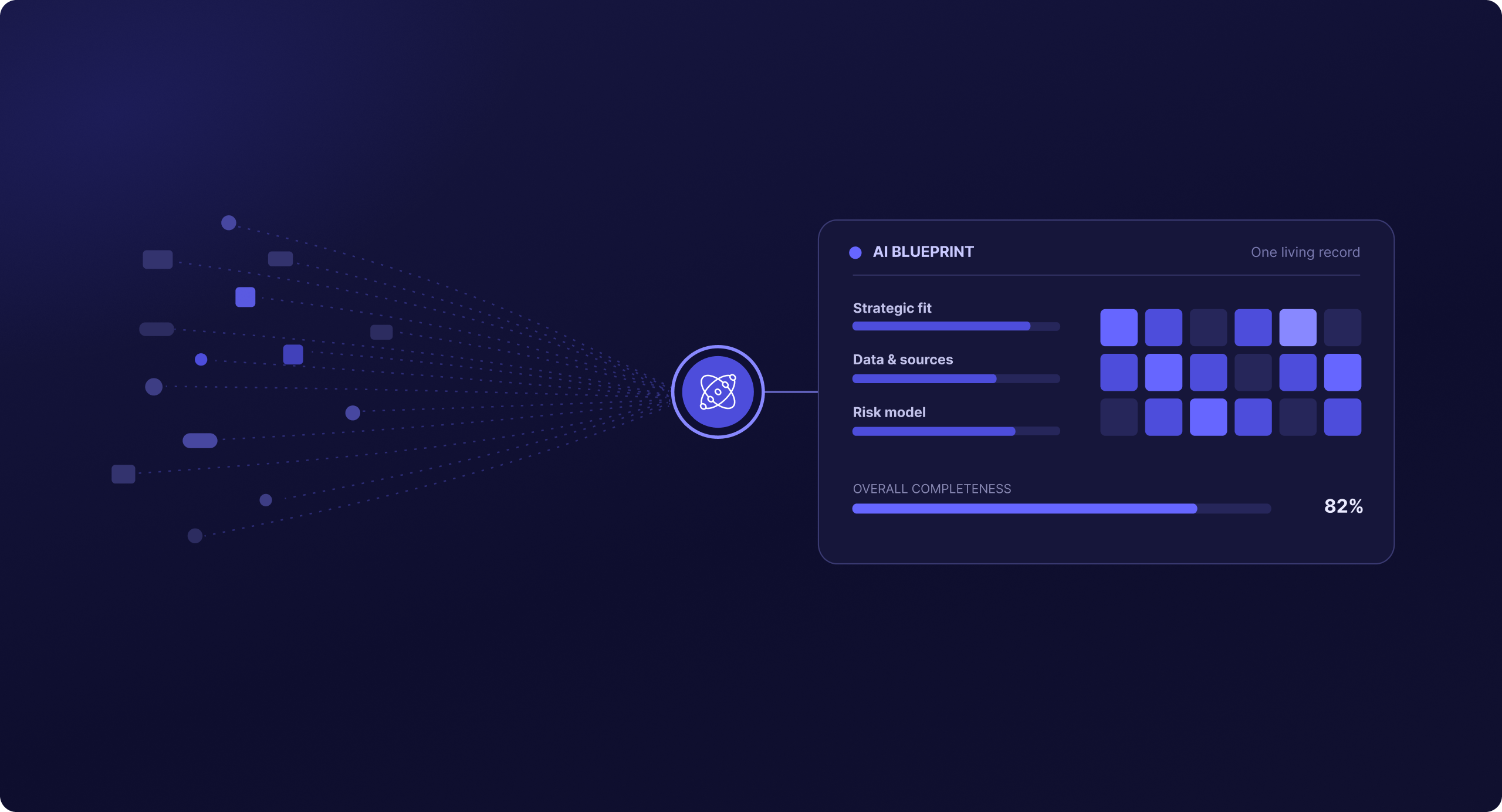
How AlignAI Turns Scattered Context Into One Living Blueprint
Getting an AI initiative from idea to production takes a clear, shared picture of risk and readiness, but most teams don't have one.
People show up with an idea but not all the data to back it up. So the responsibility to compile and make sense of it falls on whoever's reviewing it. Otherwise, the idea just bounces back and forth, adding delays. Teams have told us they spend 40 business hours per week across a team compiling this information, having meetings, and following up with teammates about it.
We know this problem resonates because at our packed house ODSC East keynote, this was exactly what we opened with. AlignAI’s answer to it is the Blueprint—a shared, living record of an initiative's context that every team builds from instead of argues and deliberates endlessly over. In this piece, we’ll go one level deeper to show how AlignAI builds the Blueprint, how it works, and what you can do once you have it.
What Is The AlignAI Blueprint?
The AlignAI Blueprint is the living record of an AI initiative's context that gets captured and builds over time, while getting reconciled continuously. It’s used for fundamental decision-making by stakeholders to ultimately go from idea to production.
It’s the same way an architectural blueprint works: An architect doesn't just take the client's wish list and start drawing. They gather constraints from the builder, the permit office, the budget, the land itself. The blueprint is the one document that the builder, the inspector, and the client can sign off on, while using for their own purposes.
That's the role AlignAI plays for an AI initiative: gathering, reconciling, and packaging context into a single, dynamic record. It stays current as the initiative moves through the cycle towards production, instead of being a static document that goes stale from the beginning.
It's collaborative by design. No single person or team fills it out, but instead information flows in through AlignAI’s Context Layer, whether via files, system integrations, notes, etc.
Why You Need an AI Blueprint
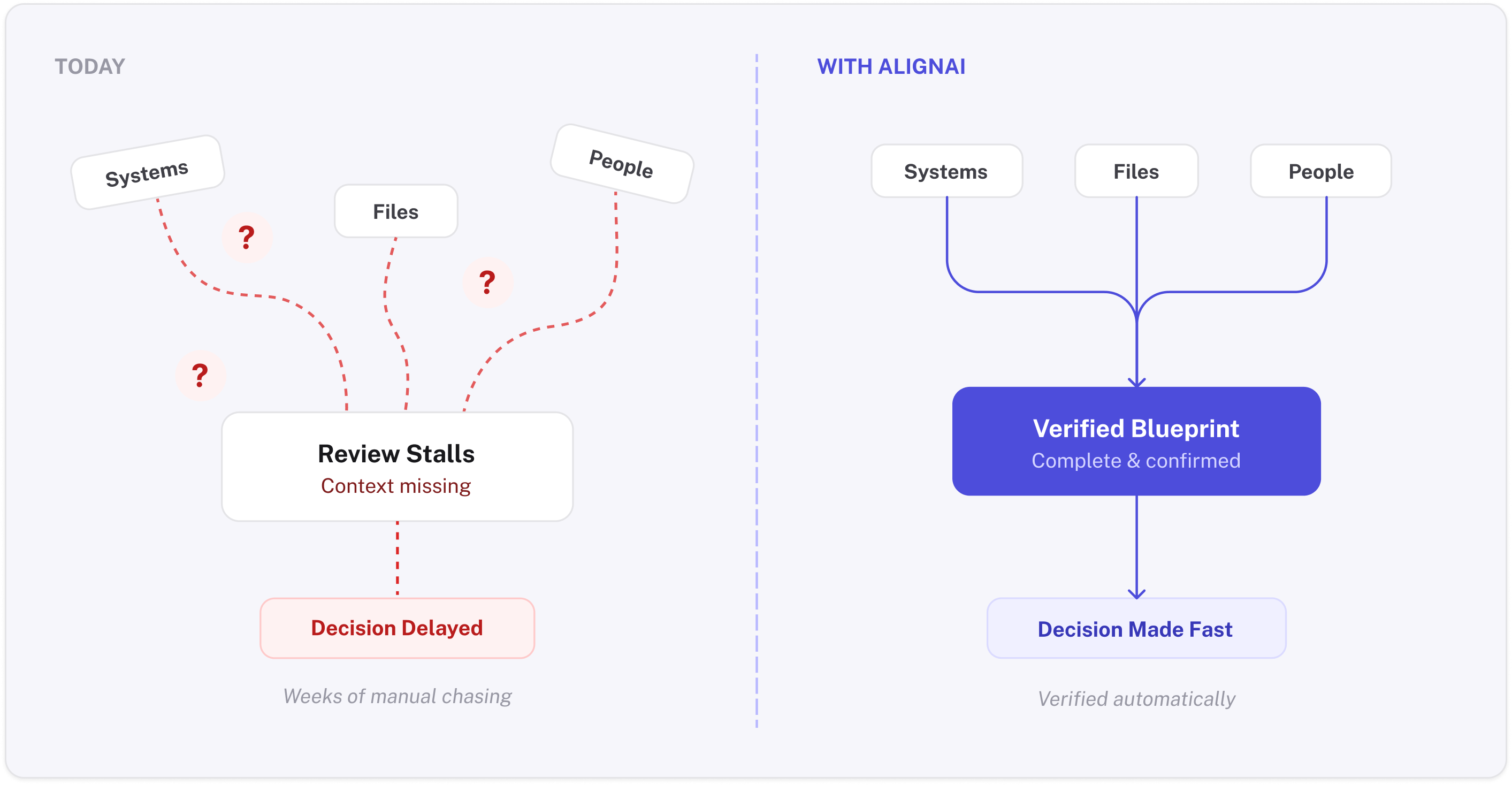
Without the Blueprint, context is scattered in spreadsheets, forgotten meeting transcripts, or in disconnected tools. It’s manually compiled, or not included as a reference when an idea gets submitted. So, the idea gets passed back and forth, slowing it down. From there, scoring can drift and reviews get subjective, without clear and enforceable mechanisms about how to know when the idea is ready and approved for production or not.
The Blueprint saves you the work of gathering context by automating it and connecting to key inputs. More importantly, it really opens what you can do once you have the context into something actionable that you have a full picture of to make the best decision on.
How AlignAI’s Blueprint Moves AI Initiatives Forward
Capturing Context
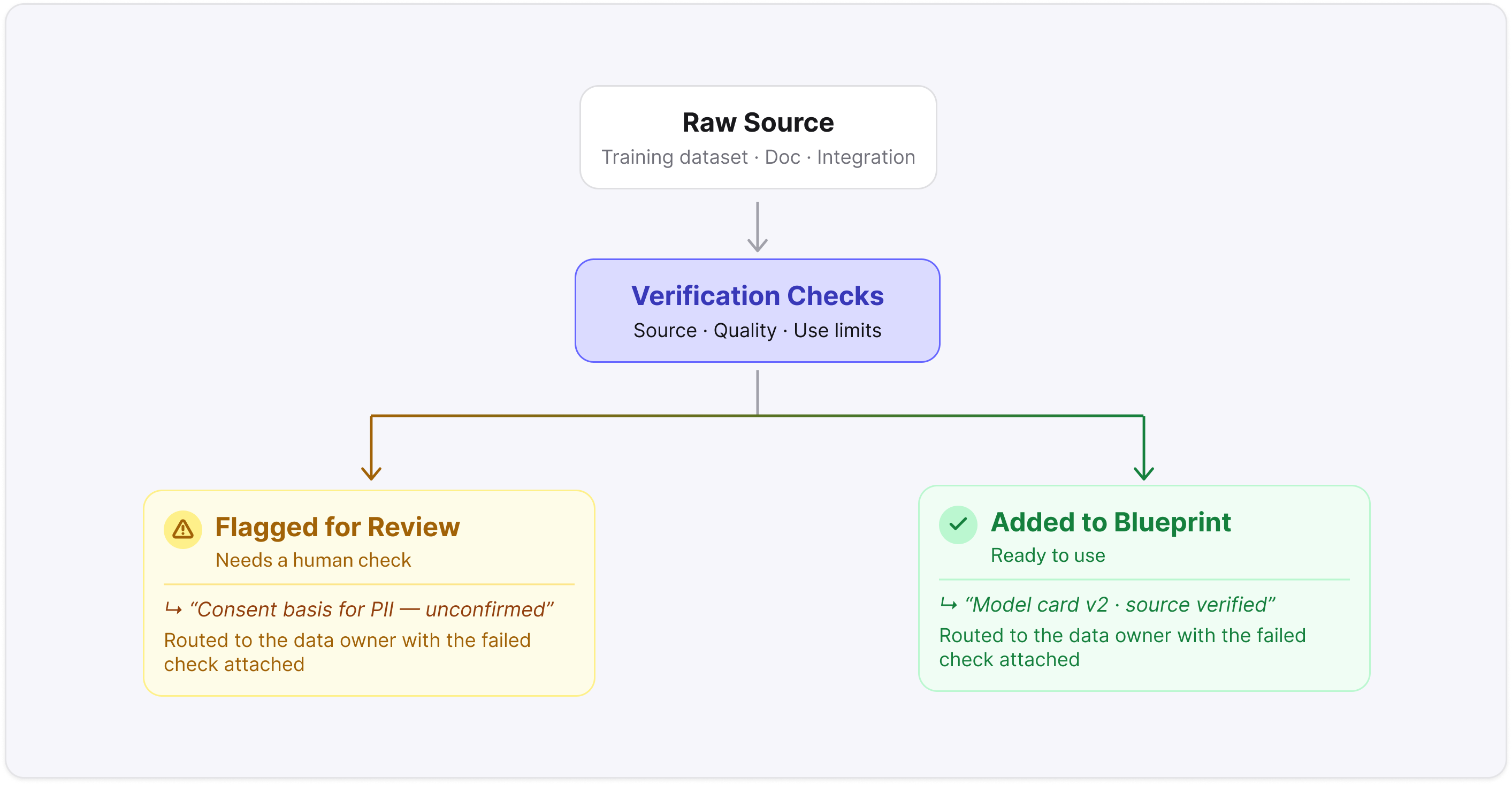
When a gap shows up (e.g., a required dataset, a missing risk classification), AlignAI identifies who or what should be answering it based on access and domain, then pulls the data directly, or routes the ask to the right person. Information comes in through integrations, or new context provided by the responsible party. New input gets cross-checked against what's already on record.
And it's flexible on how much it owns. In Workflow Mode, AlignAI actively gates an initiative's progress through stages. In Repository Mode, it continuously synthesizes the record to capture and reconcile context, then push it back out to other systems without owning the gates itself. Organizations can choose the mode based on how much process ownership they want to hand off or not.
Organizing Into Domains
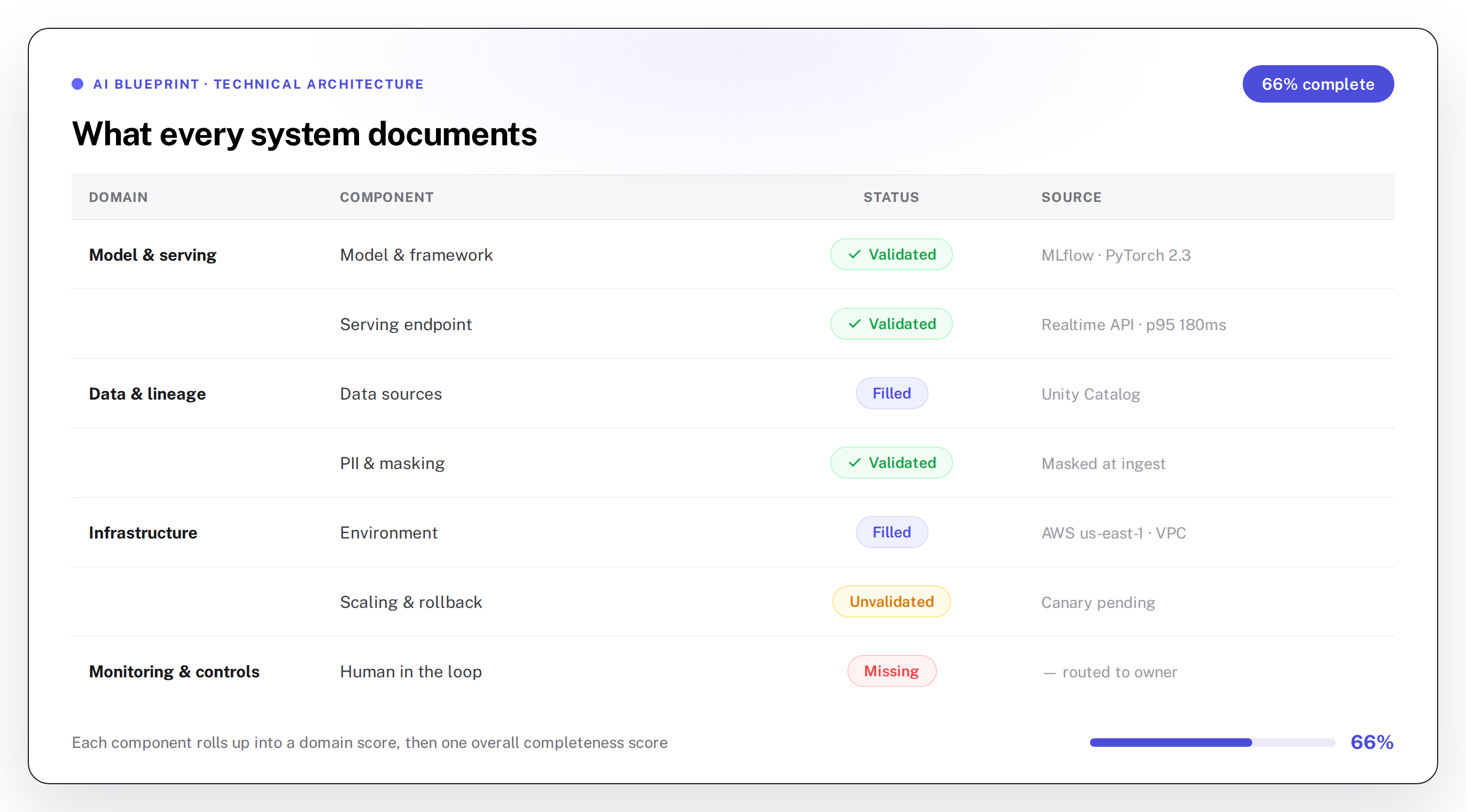
Context then gets structured into different categories and domains across areas like strategic fit, process and scope, systems, data, expected performance, architecture, requirements, and risk. Each domain has its own defined criteria for what "complete" actually means, so completeness isn't subjective.
Scoring Completeness
From here, initiatives have clear statuses across necessary criteria: missing, filled but unvalidated, or validated against a source. These all roll up into a domain score, then an overall score. You don’t have to hit 100% before something can move. It’s more about everybody seeing the same number and making the call, instead of having multiple ideas about how “ready” something is or not.
One Record, Multiple Audiences, One Final Decision
Finally, the Blueprint gets packaged up differently depending on who’s looking at it, but without having to re-explain it across handoffs. The build team gets requirements and architecture notes. The data team gets a dataset inventory with quality and access status. The risk team gets exposure and regulatory classification. Executives get strategic alignment and blockers. The accountable owner gets the full record.
The Missing Piece In Your Stack
Some teams might have a governance platform, a workflow tool, or a shared space for intake. While these inform the Blueprint, none of them tackle the work the Blueprint does that makes the difference on moving from AI idea to impact. It’s about when context gets built and who it actually serves once it exists. Here's where they fall short:
- Governance platforms document a model after it's built. The Blueprint exists from the idea stage forward, so you have something to review long before there’s a model to govern.
- Workflow tools move work through stages, but they don't necessarily build a coherent record underneath. AlignAI feeds from and into those systems rather than replacing them.
- Spreadsheets and manual tracking have no consistent way to verify or score what's submitted, require constant maintenance and management, and create exactly the gap that turns into a stalled review six months later.
Start With Your First Blueprint
A Blueprint doesn't slow governance down or cut corners to move fast. It's the best strategy to do both at once. If your team is somewhere between "we have an idea" and "we're stuck explaining it to the fourth reviewer this quarter," that's exactly where a Blueprint makes a difference.
See how your AI Blueprint can come together with AlignAI →
FAQ
What is an AI Blueprint?
The AlignAI Blueprint is the living record of an AI initiative's context that gets captured once, reconciled continuously, and used for fundamental decision-making by stakeholders to ultimately go from idea to production.
How is AlignAI different from general AI governance software?
Most governance platforms document a model after it's built. AlignAI’s Blueprint exists from the idea stage forward, so there's a coherent record to review well before there's anything to govern.
Does building an AI Blueprint slow teams down?
It's designed to speed things up by replacing the back-and-forth of manual context-gathering, with one record everyone contributes to and pulls from, instead of five separate versions of the same information.