How a top 10 U.S. bank turned AI governance into a competitive advantage

When your five-year strategy depends on AI and being #1 in customer trust, a governance process held together by spreadsheets and status meetings is a liability.
Here's how one bank built the infrastructure to match its ambition with AlignAI's purpose-built platform.
MEET THE CUSTOMER
A bank betting its five-year strategy on AI
This bank's five-year strategy is built on a clear mandate from the board: use AI to free up people in technology, give branch teams more time to deepen customer relationships, and ultimately become the most trusted bank in the country. Revenue growth tied to measurable AI outcomes is the key strategic goal the program is being held to right now.
Executing on that required a governance framework that could function as a platform for innovation, not a bottleneck to it. And that's exactly what the team was up against.
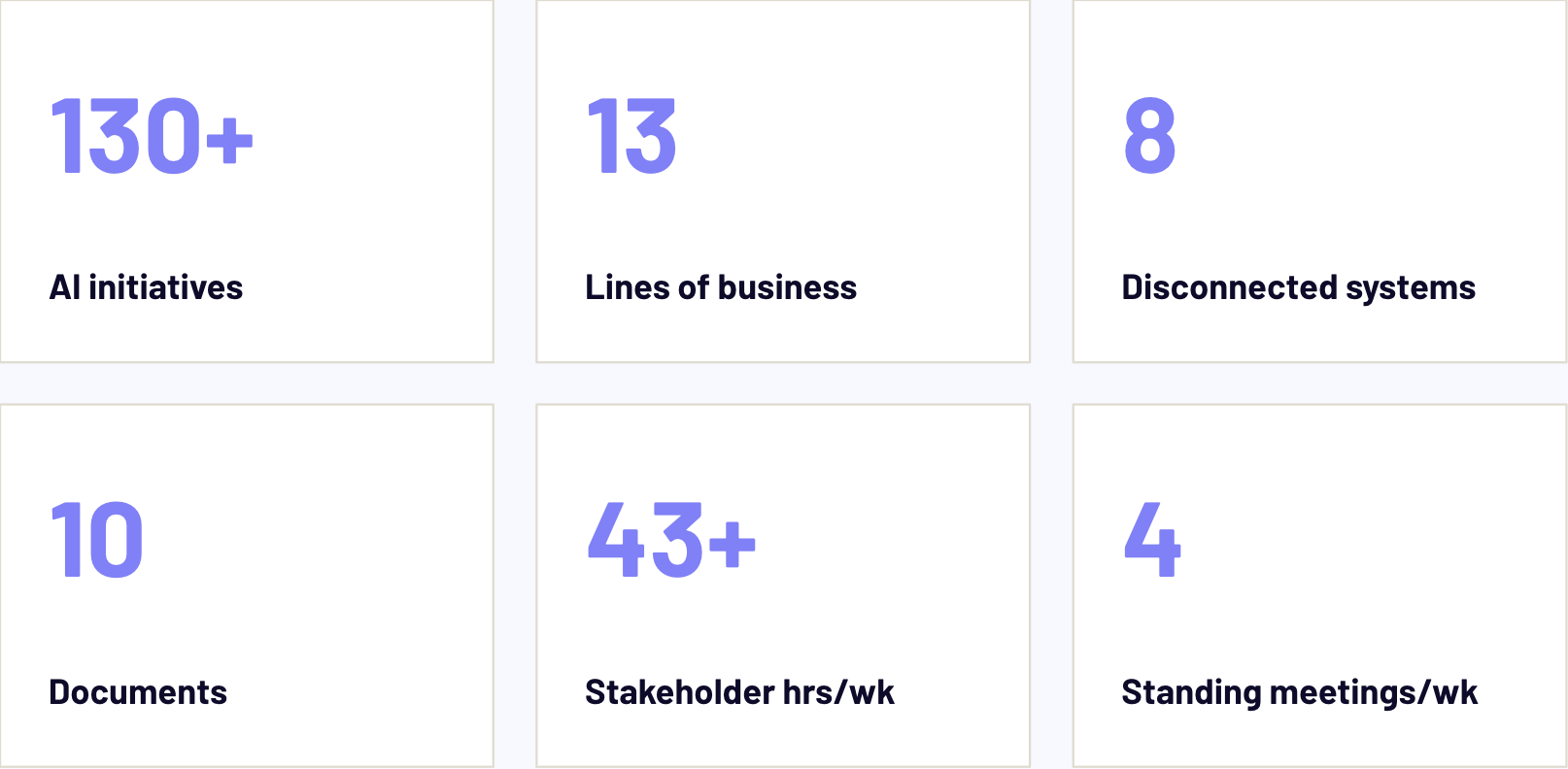
The bank manages more than 130 active AI initiatives across 13 lines of business, overseen by a dedicated governance team, a model risk management function, and segment leads working to bring AI to production responsibly and at speed.
As the program grew, so did the coordination burden. What started as a manageable process had become a full-time logistics challenge: eight separate systems, 10 documents, 43+ stakeholder hours per week, and four standing meetings just to have some semblance of visibility across the pipeline.
As the program grew, so did the coordination burden:
THE CHALLENGE
A process that couldn't keep up.
No single place to manage the process
Every AI use case touched ADO, MS Teams, SharePoint, Archer, ServiceNow, Jira, and Power BI. Reviewers spent more time searching for information and context across systems than they did making strategic decisions.
Fragmented intake caused duplicate work
The lifecycle required two separate intake forms (one at ideation, one at governance) with overlapping questions. Submitters were asked to re-enter information they had already provided, with no guarantee that the information carried forward accurately between stages, and no visibility into what happened after submission and its status as it progressed.
Manual scoring was unscalable
The AI risk lead personally scored each AI initiative using a multi-tab spreadsheet. As the program scaled, rating consistency became harder to ensure. Living in a spreadsheet versus system made iteration nearly impossible. Any change to the scoring logic meant manually updating every future assessment and hoping past ratings could still be compared.
Half the cycle was idle waiting time
Use cases would sit in queues until manually reviewed, fully documented, and then manually routed for the next approval step. As work progressed through each tool and stage, stakeholders needed manual notification, causing further delays. In a 9-month build cycle, only ~4.5 months involved active work.
Governance didn’t have a full picture of risk
The governance team couldn’t confidently answer how many tools were in review at any given time, much less assess their full risk profile. Time was spent following up with submitters for clarification rather than advancing use cases through review.
40 hours of meetings to enforce the process
With no live dashboard, four recurring status meetings per week served as the only mechanism to truly understand what was happening. Portfolio health didn’t depend on data as much as it did everybody’s calendar availability.
THE BREAKING POINT
Answering a basic question prompted peak frustrations
"I thought, if I could link everybody to something where they could see all these activities happening and the context... then we could stop having so many meetings." - AI Risk Program Lead, Top 10 U.S. Commercial Bank
The signals had been building for a while. Executives needed visibility into the AI portfolio that the governance team simply couldn't provide on demand because the data wasn’t in one place. The portfolio had outgrown the manual process holding it together, and everyone could feel it.
The problem crystallized when governance realized they had four separate lists tracking the same portfolio of AI tools, but each list had a different count. It meant they couldn't give leadership a straight answer on the most basic question: how many AI initiatives are we actually governing right now? Forget trying to figure out which ones were the highest risk, most valuable, or approval timelines.
For a bank whose board had explicitly tied its five-year strategy to measurable AI outcomes, this limitation would essentially guarantee they wouldn’t get there. They knew simply improving the process wouldn’t fix it. They needed a new approach and tool to govern their AI initiatives.
THE SOLUTION
A single platform to standardize, score, and move AI forward
The bank evaluated their options, including building something on top of ServiceNow. AlignAI won across speed, usability, and flexibility. Where ServiceNow would have taken months to configure and deploy, AlignAI had them up and running in a fraction of the time.
AlignAI's team worked with the bank's governance leads to establish a repeatable, enforceable process from the ground up, drawing on a decade of AI program design experience across regulated financial services organizations. The process they built was customizable enough to match how they actually worked while bringing the structure and consultation they needed to make it better. The result wasn't just a new tool, but a new operating model.
One intake system, mapped to their exact needs
AlignAI replaced two separate, overlapping intake forms with a single structured portal featuring: required fields, dropdown enforcement aligned with their data classification policy, and conditional logic that shows only fields relevant to each use case type.
Automated risk scoring in 2–5 minutes
AlignAI’s scoring engine encodes the bank’s risk logic across four categories: Compliance, Data Integrity, Accountability, and Transparency. Yes/No intake answers auto-calculate a system-generated risk rating. The AI risk lead reviews, adjusts if needed, and moves on — a process that now takes 2–5 minutes compared to a full manual spreadsheet assessment. The human stays in the loop; the manual work is eliminated.
Role-based views that keep reviews moving
Everyone works in AlignAI, with views calibrated to exactly what they need: governance leads see every phase in a triage view, SMEs see only their queue, and executives see a live portfolio summary. Initiative reviews and approvals keep moving without anyone having to track everything down manually across multiple tools.
No more chasing the next step or stakeholder
As initiatives progress, automatic notification triggers send updates to stakeholders. Use cases no longer sit silently in queues. A dedicated MRM bounce-back transition routes incomplete documentation back to the tool owner and resets the SLA clock automatically, making each party’s contribution to cycle time visible and auditable for the first time.
One AI system of reference across the stack
With automated data handoffs via integrations, leadership at the CDAO, CIO, and CFO’s office now has real-time views of portfolio risk by segment, pipeline stage, and SLA performance via Power BI. The visibility is operationally useful and how they hold the program accountable to the board's mandate.
THE RESULTS
Faster approvals. Less coordination. Full visibility.
“There's no waiting, no transition, no handoffs. All that idle time that was doubling our implementation period is eliminated.” - AI Risk Lead
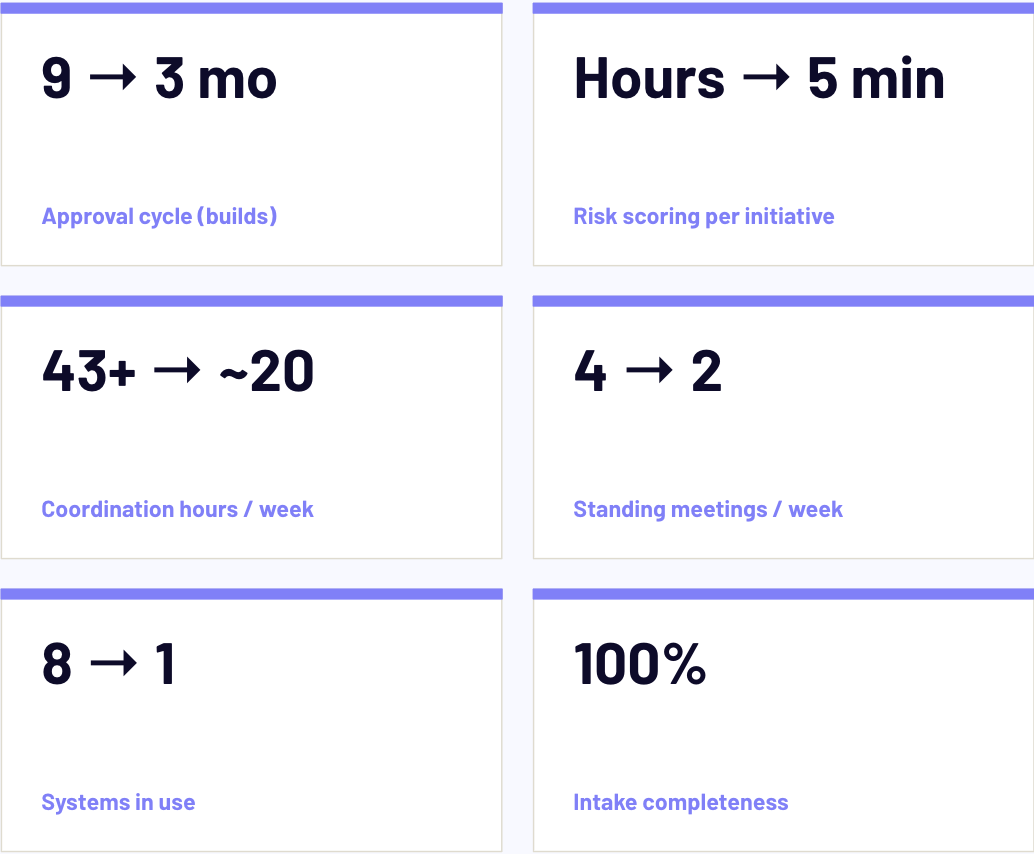
BEFORE AND AFTER
“With AlignAI, I have all of the information right here. When I did this process before, I was jumping around between three to four different systems and it was a scrambled mess. Now, it’s all centrally located, so I can rate and see responses and put my assessor judgment in a single place.” - AI Risk Lead
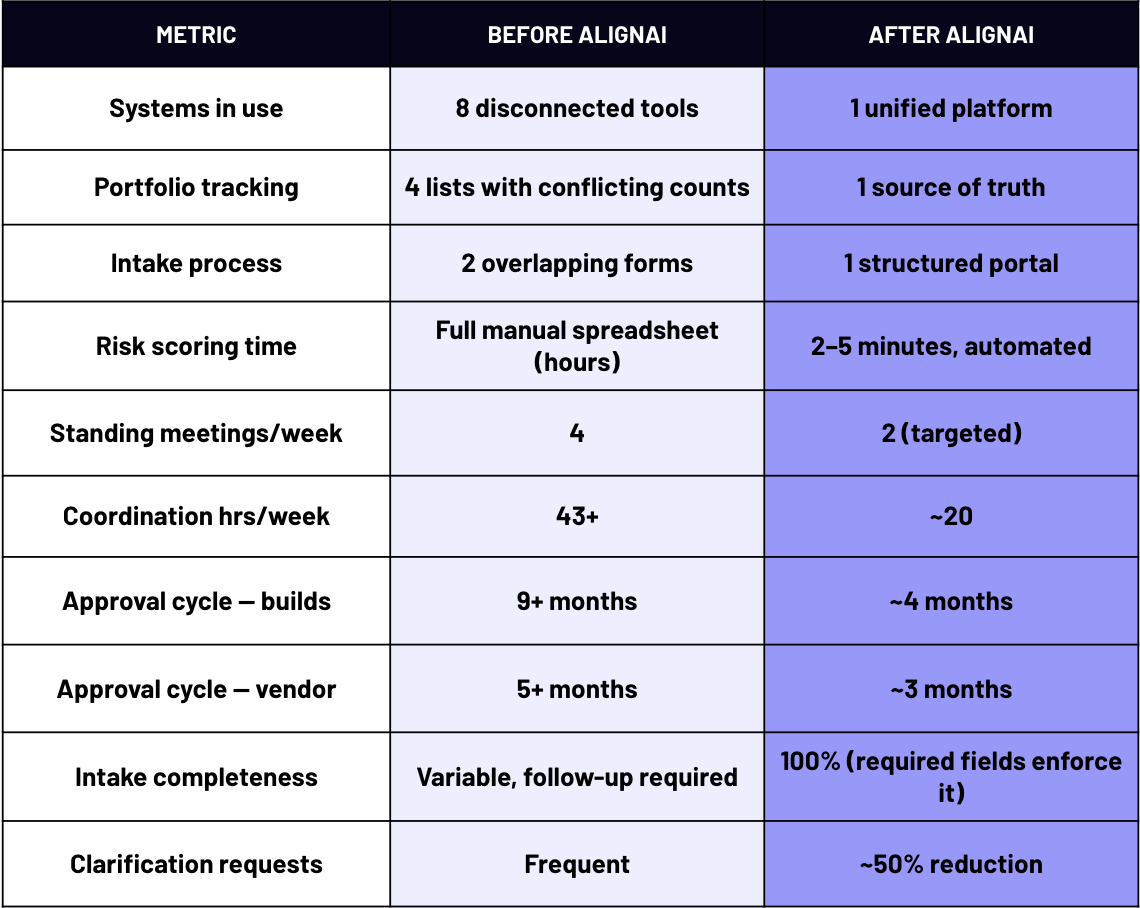
The shift, line by line
The impact shows up across the entire approval lifecycle—from the moment a use case is submitted to when it clears governance and reaches production.
WHAT'S NEXT
From pilot to platform
The bank’s investment in AlignAI is expanding beyond its initial deployment. Three signals point to where the relationship is headed:
Scaling across all 13 lines of business across the enterprise
After an internal innovation workshop and a series of executive demos, leadership saw the program in action. They greenlit expanding AlignAI across the full organization.
Dedicated internal ownership
The bank now has a dedicated internal role to manage AlignAI operations and AI program oversight—signals that governance moved from mere compliance function to a core piece of how the organization runs and grows its AI program overall.
Executive-level visibility
CDAO, CIO, and CFO-level stakeholders are now active users of AlignAI’s dashboards. They not only track where initiatives stand, but also get a strong sense of how the program delivers against the board’s targets for AI-driven revenue growth and trust.
It's time to get aligned.
If your team is spending more time managing the basic process than running the program, that's the signal you need a solution like AlignAI.
See what a purpose-built AI governance platform looks like in practice.