Why Enterprise AI Programs Never Deliver Their Biggest Wins (There’s a Missing Layer Nobody Talks About)
Why Enterprise AI Programs Never Deliver Their Biggest Wins (There’s a Missing Layer Nobody Talks About)
Blog
Featured
Latest
·
Rehgan Bleile
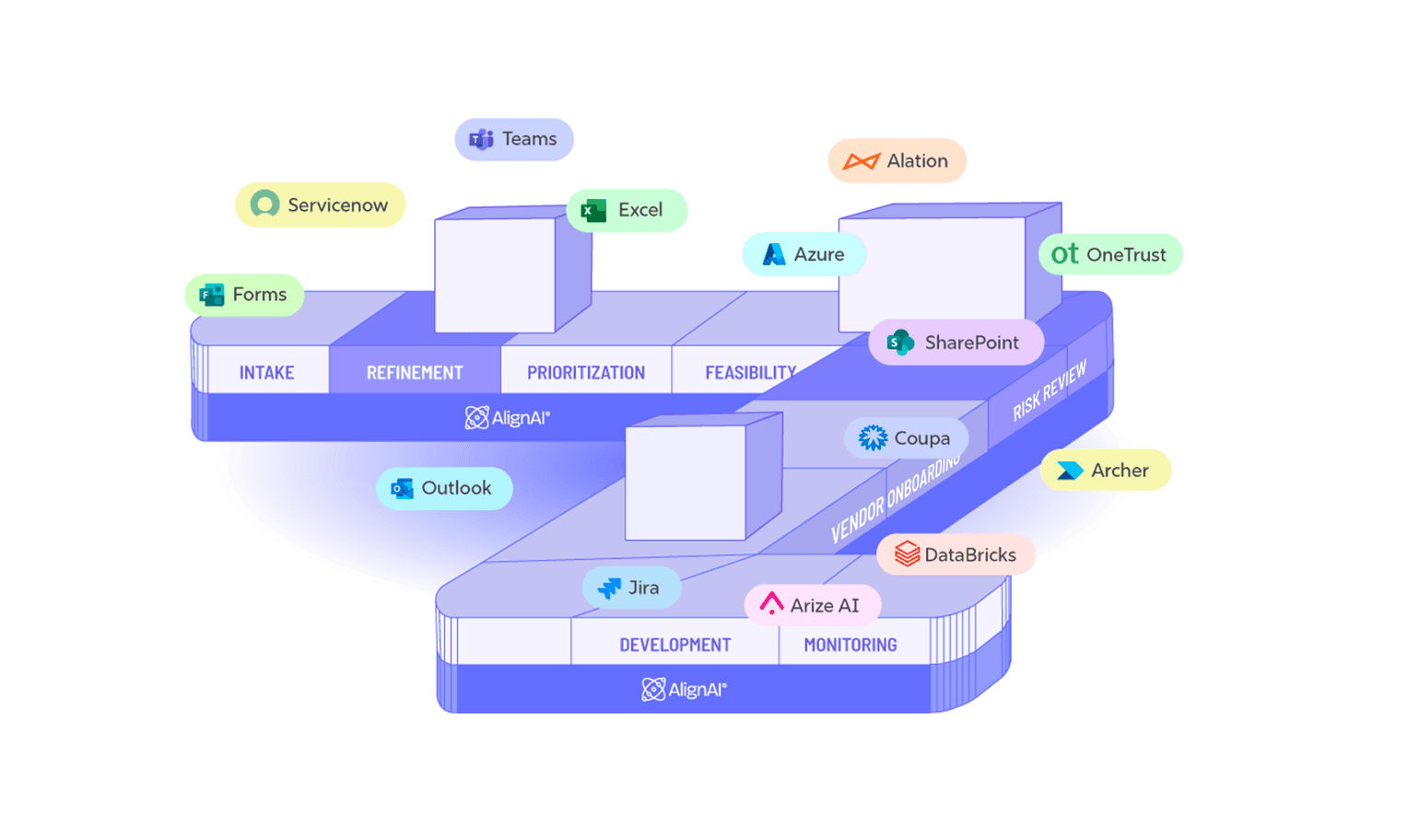
Most enterprises can’t systematically operationalize their AI initiatives, so they go much slower than they need to. Not because teams aren’t working on it, but because there’s no connected layer managing the AI lifecycle end-to-end. Every stage runs through different tools and teams, objectives and governance decisions go unenforced. On top of that, AI initiatives are technically complex systems to launch, spanning data readiness, risk, architectural fit, and what it actually takes to get live and adopted.
This missing lifecycle management layer and the technical complexity bring major coordination headaches, but most enterprises simply accept that “that’s the way it is.” The real problem runs deeper, though. This high-effort coordination is why your highest-value AI opportunities get lost at intake, why you can't identify your best bets, and why you'll never hit audacious targets—let alone prove you did.
Without a unified data model across the AI lifecycle, enterprises cannot unlock the full strategic value of their AI programs. Here, we’ll break down exactly what that data model requires, why today's tools can't get you there, and what it takes to get the intelligence layer your AI program is missing.
Slow Coordination Is A Surface Problem—The Real Issue Runs Deeper
Running an AI program inside a large enterprise today looks something like this:
Intake through ServiceNow requests or Microsoft Forms
Refinement across Teams meetings and Outlook mails
Prioritization scored in Excel sheets or Portfolio Management tools
Feasibility assessment by sifting through data catalogs, or Azure experimentation
Risk reviews stored in Archer, OneTrust, or another GRC platform
Policies scattered across SharePoint, slide decks, and Google Docs
Project execution runs through Jira
Monitoring in Databricks, Azure, or Arize AI
Governance decisions in committee meetings — live conversations, not systems
Vendor management in procurement tools to onboard vendors
Each tool does its job, but nothing connects them end-to-end, nor between stages. This is where AI programs break down.
Ideas bounce around, or go nowhere.
Teams handoff their piece, then disengage.
Progress depends on manual follow-ups.
Unclear stage gates and approvals stall momentum.
Governance requirements get discussed, but never systematized.
Key program metadata, requirements, and goals aren’t visible or enforced downstream.
The poor coordination is frustrating, and many enterprises simply accept that this is how things work. For one, you don’t have to work like this (you can try a workflow like this). For two, it’s not the worst problem.
The deeper problem is that trying to implement AI initiatives this way is costing you the ability to easily deliver, measure, and prove AI value. Eventually you will lose to others who master this.
When your CEO or CFO asks what the next big idea is, where you’re at, or why things aren’t moving faster, you might have a guess but no simple way to back it up—because the data to construct that answer doesn't exist in one place, or at all. Without a unified data model for your end-to-end AI lifecycle, you're only guessing about how to make it better and more impactful.
The Three Stages to Real AI Program Maturity
Organizations that get AI working at scale build through three distinct stages.
Stage 1: Design a Standardized but Adaptable Process
The most important piece here is having a consistent way to evaluate value, priority, risk, and opportunities—and a repeatable process to move initiatives from idea to implementation.
This means clearly defined AI program stage gates: entry criteria, exit criteria, and shared expectations at every step. It needs to be scalable, accounting for changes and new insights over time.
Most enterprises are stuck here. The ones that do move past it often lock in a mediocre process and never revisit it, because changing it across their existing tools is too painful.
Stage 2: Set Enforceable Boundaries at Each Step
Then you need a process that doesn’t just live on paper, but is enforceable. Stage 2 is where technology facilitates handoffs, keeps stakeholders accountable, and prevents bottlenecks before they form. It doesn’t sit by idly waiting for manual intervention.
Organizations that reach Stage 2 typically get there using status quo tools that weren't built for AI program management—disconnected systems that solve one piece, not the whole thing. They then get stuck here every time something in Stage 1 changes (and it should, as your program matures). Rebuilding enforcement across cobbled-together tools is expensive enough that most organizations simply don't. They live with a rigid process that gets more outdated every quarter.
Stage 3: Operationalize the Intelligence Layer
Stage 3 is when you have a standardized process (Stage 1), technology that enforces it (Stage 2), and a unified data model across the entire lifecycle (Stage 3). It's where everything connects.
In practice, this means:
Every initiative carries consistent metadata.
Risk findings and governance decisions are baked into execution.
Portfolio-wide patterns become visible: what succeeds, where bottlenecks form, risk categories.
Initiatives move seamlessly through each stage with confidence that they've met the requirements to proceed.
You can track initiatives start to finish and assess what’s truly valuable.
This isn't just moving faster. It's knowing how fast you're moving and why.
The hard truth: most companies are stuck on Stage 1. The few that make it to Stage 2 find it isn't scalable, and it eventually breaks down. Stage 3 is unreachable without a centralized data model, which today’s status quo tools cannot produce.
Why Stage 3’s Intelligence Layer Is Out of Reach (And Why it’s Costing You)
Without Stage 3’s intelligence layer you can't do any of the following:
Mine for your highest-value AI bets. You don't have the data to identify which initiatives have the best combination of business impact, feasibility, and acceptable risk.
Identify optimal risk/effort/value combinations. Every initiative is evaluated in isolation, not in the context of the full portfolio.
Improve your operating model over time. Without data about how your process performs, you can't systematically get better at it.
Get outsized value from existing initiatives instead of constantly bringing on new vendors or starting new projects.
Hit audacious enterprise goals — and prove that you did. If Finance sets a $20M AI value target, which initiatives contribute? Where is that tracked? How do you validate it?
Ensure AI systems go live in production and get adopted. There’s no “mission control” to confirm what’s approved, live, and how and where it’s being used.
Gain a competitive advantage at a time when speed matters. Competitive advantage in the market is accelerating as more enterprises leverage AI. You cannot fall behind.
You Can’t Win Bets You Don’t Place
AI initiatives aren't a simple to-do list with estimated dollar values. They bring complexity across value, data readiness, architectural fit, risk profile, and what it actually takes to go live and get adopted.
Without a unified view, organizations default to what seems achievable:
"Launch X, it's $500K of value—easy win."
The $10M initiative? Too complicated, too risky, too hard to manage start to finish. So it gets lost at intake or never gets the support it needs.
If you only do the easy stuff, you will never hit the numbers your leadership is demanding. You'll never know what the best bets are. And you'll never home in on what will actually win.
You Cannot Hit Millions in AI Value (Nor Prove You Did)
This is where it gets expensive.
If Finance sets a $20M AI value target, which initiatives contribute? Where is that tracked? How do you validate it when the audit comes?
Without a unified data model, you can't track that value end-to-end. You're left aggregating numbers from disconnected systems, reconstructing timelines from email threads, and relying on anecdotal evidence. It's not credible, it's not scalable, and it won't survive an audit.
You cannot guess your way to $20M.
How AlignAI Brings You to True AI Program Maturity
AlignAI helps enterprises move through Stage 1 and Stage 2 faster than going it alone, or using tools not built for the job—that’s what makes Stage 3's intelligence layer actually viable.
We help you build a scalable, standardized process (Stage 1) to refine and approve AI initiatives (Stage 2) in one collaborative platform that sits on top of all your existing systems (Stage 3). Your teams keep working in the systems they already use, but now those systems feed into a unified data model that captures everything happening across the lifecycle.
Because AlignAI is purpose-built for this, changes to your lifecycle process can be implemented quickly and reflected in the enforcement layer — without rebuilding from scratch. The nuance of those changes gets captured in the data model. That's simply not possible with status quo tools.
The result: the $10M initiative that's currently getting lost at intake or seems too complicated? It becomes viable. You can finally analyze optimal effort-and-outcome combinations across your full portfolio. Right now, nobody has the ability to analyze that appropriately, but with a unified data model, you do. And yes, the coordination headaches stop.
The Bottom Line
A healthy AI program needs all three stages:
a standardized process
technology that enforces it
an intelligence layer built on a unified data model.
Without all three, you won't hit executive targets. You won't know your best bets. You won't prove AI ROI.
The gap between organizations that operationalize AI quickly and those that don't is widening. The cost of cobbling this together isn’t the annoying coordination, but the strategic opportunity you're leaving on the table that compounds for every quarter you can’t operationalize your AI program management.
Ready to Get Your AI Intelligence Layer?
See how AlignAI helps enterprises operationalize their AI lifecycle → [Book a demo]
Most enterprises can’t systematically operationalize their AI initiatives, so they go much slower than they need to. Not because teams aren’t working on it, but because there’s no connected layer managing the AI lifecycle end-to-end. Every stage runs through different tools and teams, objectives and governance decisions go unenforced. On top of that, AI initiatives are technically complex systems to launch, spanning data readiness, risk, architectural fit, and what it actually takes to get live and adopted.
This missing lifecycle management layer and the technical complexity bring major coordination headaches, but most enterprises simply accept that “that’s the way it is.” The real problem runs deeper, though. This high-effort coordination is why your highest-value AI opportunities get lost at intake, why you can't identify your best bets, and why you'll never hit audacious targets—let alone prove you did.
Without a unified data model across the AI lifecycle, enterprises cannot unlock the full strategic value of their AI programs. Here, we’ll break down exactly what that data model requires, why today's tools can't get you there, and what it takes to get the intelligence layer your AI program is missing.
Slow Coordination Is A Surface Problem—The Real Issue Runs Deeper
Running an AI program inside a large enterprise today looks something like this:
Intake through ServiceNow requests or Microsoft Forms
Refinement across Teams meetings and Outlook mails
Prioritization scored in Excel sheets or Portfolio Management tools
Feasibility assessment by sifting through data catalogs, or Azure experimentation
Risk reviews stored in Archer, OneTrust, or another GRC platform
Policies scattered across SharePoint, slide decks, and Google Docs
Project execution runs through Jira
Monitoring in Databricks, Azure, or Arize AI
Governance decisions in committee meetings — live conversations, not systems
Vendor management in procurement tools to onboard vendors
Each tool does its job, but nothing connects them end-to-end, nor between stages. This is where AI programs break down.
Ideas bounce around, or go nowhere.
Teams handoff their piece, then disengage.
Progress depends on manual follow-ups.
Unclear stage gates and approvals stall momentum.
Governance requirements get discussed, but never systematized.
Key program metadata, requirements, and goals aren’t visible or enforced downstream.
The poor coordination is frustrating, and many enterprises simply accept that this is how things work. For one, you don’t have to work like this (you can try a workflow like this). For two, it’s not the worst problem.
The deeper problem is that trying to implement AI initiatives this way is costing you the ability to easily deliver, measure, and prove AI value. Eventually you will lose to others who master this.
When your CEO or CFO asks what the next big idea is, where you’re at, or why things aren’t moving faster, you might have a guess but no simple way to back it up—because the data to construct that answer doesn't exist in one place, or at all. Without a unified data model for your end-to-end AI lifecycle, you're only guessing about how to make it better and more impactful.
The Three Stages to Real AI Program Maturity
Organizations that get AI working at scale build through three distinct stages.
Stage 1: Design a Standardized but Adaptable Process
The most important piece here is having a consistent way to evaluate value, priority, risk, and opportunities—and a repeatable process to move initiatives from idea to implementation.
This means clearly defined AI program stage gates: entry criteria, exit criteria, and shared expectations at every step. It needs to be scalable, accounting for changes and new insights over time.
Most enterprises are stuck here. The ones that do move past it often lock in a mediocre process and never revisit it, because changing it across their existing tools is too painful.
Stage 2: Set Enforceable Boundaries at Each Step
Then you need a process that doesn’t just live on paper, but is enforceable. Stage 2 is where technology facilitates handoffs, keeps stakeholders accountable, and prevents bottlenecks before they form. It doesn’t sit by idly waiting for manual intervention.
Organizations that reach Stage 2 typically get there using status quo tools that weren't built for AI program management—disconnected systems that solve one piece, not the whole thing. They then get stuck here every time something in Stage 1 changes (and it should, as your program matures). Rebuilding enforcement across cobbled-together tools is expensive enough that most organizations simply don't. They live with a rigid process that gets more outdated every quarter.
Stage 3: Operationalize the Intelligence Layer
Stage 3 is when you have a standardized process (Stage 1), technology that enforces it (Stage 2), and a unified data model across the entire lifecycle (Stage 3). It's where everything connects.
In practice, this means:
Every initiative carries consistent metadata.
Risk findings and governance decisions are baked into execution.
Portfolio-wide patterns become visible: what succeeds, where bottlenecks form, risk categories.
Initiatives move seamlessly through each stage with confidence that they've met the requirements to proceed.
You can track initiatives start to finish and assess what’s truly valuable.
This isn't just moving faster. It's knowing how fast you're moving and why.
The hard truth: most companies are stuck on Stage 1. The few that make it to Stage 2 find it isn't scalable, and it eventually breaks down. Stage 3 is unreachable without a centralized data model, which today’s status quo tools cannot produce.
Why Stage 3’s Intelligence Layer Is Out of Reach (And Why it’s Costing You)
Without Stage 3’s intelligence layer you can't do any of the following:
Mine for your highest-value AI bets. You don't have the data to identify which initiatives have the best combination of business impact, feasibility, and acceptable risk.
Identify optimal risk/effort/value combinations. Every initiative is evaluated in isolation, not in the context of the full portfolio.
Improve your operating model over time. Without data about how your process performs, you can't systematically get better at it.
Get outsized value from existing initiatives instead of constantly bringing on new vendors or starting new projects.
Hit audacious enterprise goals — and prove that you did. If Finance sets a $20M AI value target, which initiatives contribute? Where is that tracked? How do you validate it?
Ensure AI systems go live in production and get adopted. There’s no “mission control” to confirm what’s approved, live, and how and where it’s being used.
Gain a competitive advantage at a time when speed matters. Competitive advantage in the market is accelerating as more enterprises leverage AI. You cannot fall behind.
You Can’t Win Bets You Don’t Place
AI initiatives aren't a simple to-do list with estimated dollar values. They bring complexity across value, data readiness, architectural fit, risk profile, and what it actually takes to go live and get adopted.
Without a unified view, organizations default to what seems achievable:
"Launch X, it's $500K of value—easy win."
The $10M initiative? Too complicated, too risky, too hard to manage start to finish. So it gets lost at intake or never gets the support it needs.
If you only do the easy stuff, you will never hit the numbers your leadership is demanding. You'll never know what the best bets are. And you'll never home in on what will actually win.
You Cannot Hit Millions in AI Value (Nor Prove You Did)
This is where it gets expensive.
If Finance sets a $20M AI value target, which initiatives contribute? Where is that tracked? How do you validate it when the audit comes?
Without a unified data model, you can't track that value end-to-end. You're left aggregating numbers from disconnected systems, reconstructing timelines from email threads, and relying on anecdotal evidence. It's not credible, it's not scalable, and it won't survive an audit.
You cannot guess your way to $20M.
How AlignAI Brings You to True AI Program Maturity
AlignAI helps enterprises move through Stage 1 and Stage 2 faster than going it alone, or using tools not built for the job—that’s what makes Stage 3's intelligence layer actually viable.
We help you build a scalable, standardized process (Stage 1) to refine and approve AI initiatives (Stage 2) in one collaborative platform that sits on top of all your existing systems (Stage 3). Your teams keep working in the systems they already use, but now those systems feed into a unified data model that captures everything happening across the lifecycle.
Because AlignAI is purpose-built for this, changes to your lifecycle process can be implemented quickly and reflected in the enforcement layer — without rebuilding from scratch. The nuance of those changes gets captured in the data model. That's simply not possible with status quo tools.
The result: the $10M initiative that's currently getting lost at intake or seems too complicated? It becomes viable. You can finally analyze optimal effort-and-outcome combinations across your full portfolio. Right now, nobody has the ability to analyze that appropriately, but with a unified data model, you do. And yes, the coordination headaches stop.
The Bottom Line
A healthy AI program needs all three stages:
a standardized process
technology that enforces it
an intelligence layer built on a unified data model.
Without all three, you won't hit executive targets. You won't know your best bets. You won't prove AI ROI.
The gap between organizations that operationalize AI quickly and those that don't is widening. The cost of cobbling this together isn’t the annoying coordination, but the strategic opportunity you're leaving on the table that compounds for every quarter you can’t operationalize your AI program management.
Ready to Get Your AI Intelligence Layer?
See how AlignAI helps enterprises operationalize their AI lifecycle → [Book a demo]